Colonel Richard Graves’ Regiment of Horse
| Flag Illustration | 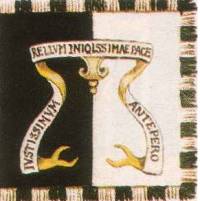 1) 1) |
| Active | 1645 to 1649 |
| Country | England |
| Allegiance | Parliamentarian |
| Conflicts | First Civil War |
| Second Civil War | |
| Type | Horse |
| Colonel | Richard Graves |
| Adrian Scroope | |
| Area Raised | |
| Flag Colour | black & white? |
| Flag Design | see below |
| Field Armies | NMA 1645-6 |
| Horton 1648 | |
| Cromwell 1648 | |
| Fairfax 1648 | |
Later Colonel Adrian Scroope’s Regiment of Horse
New Model Army regiment of horse serving in the First and Second Civil Wars but disbanded after joining the Leveller mutiny of 1649
Service History
1645
- April: Formed from the Earl of Essex’s Regiment of Horse of Essex’s Army
- May: Relief of Taunton
- May to July: Besieged in Taunton
- July: Battle of Langport
- August to September: Siege of Bristol
- September: Quartered at Thame
- September: Skirmish at Thame
- September: Battle of Rowton Heath (5 troops)
- November: Battle of Denbigh Green
1646
- May to June: Siege of Oxford
1647
- January: Escort pay for the Scots to Newcastle
- February: Escort King Charles I to Holdenby House
- June: Scroope replaces Graves
1648
- March: Suppress riot at Blandford (3 troops under Col Scroope)
- April: Take Brecon (3 troops under Maj Barton)
- May: Quartered in Dorset (Scroope)
- May: Battle of St Fagans (Barton)
- May: Siege of Tenby (Barton)
- May: Siege of Pembroke Castle (Barton)
- June: Sent north to oppose the Scots (Barton)
- June to July: Siege of Colchester (Scroope)
- July: Skirmish at St Neots (Scroope)
- July: Quartered at Yarmouth (Scroope)
- August: Battle of Preston (Barton)
- August: Battle of Winwick Pass (Barton)
1649
- April: Selected by lot for service in Ireland
- April: Mutiny on being ordered to Ireland
- May: Mutiny quashed at Burford
- June: Disbanded
Notes
A history of the regiment is given in The Regimental History of Cromwell's Army by Sir Charles Firth and Godfrey Davies, Clarendon Press, Oxford, 1940.
The regiment was formed from the Earl of Essex’s Regiment of Horse. Sent to relieve Taunton with Weldon’s brigade, they missed Naseby, but re-joined the main army for Langport and the siege of Bristol. Quartered at Thame in September, they were defeated in a skirmish by Oxford forces under Robert Legge. They were then ordered north and fought at the Battle of Rowton Heath in Cheshire, returning south to serve at the siege of Oxford.
At the start of the Second Civil War the regiment was split in two, with three troops under Colonel Scroope in Dorset and three troops under Major Barton serving with Horton in South Wales. Barton’s half-regiment fought at St Fagans and was later sent north by Cromwell, serving at the Battle of Preston. Scroope’s remaining three troops reinforced Fairfax at the siege of Colchester and notably captured the Earl of Holland in a skirmish at St Neots.
The majority of the regiment joined the Leveller mutiny of 1649, leaving only 80 men loyal to Colonel Scroope. The mutiny ended with the capture of the mutineers by Fairfax and Cromwell at Burford. Three ringleaders, Cornet James Thompson and Corporals Perkins and John Church were executed by firing squad against the wall of Burford Church. The bullet holes in the church can still be seen and the Levellers are commemorated annually in Burford. The remains of the regiment were disbanded in June 1649.
Flags and Equipment
Graves' regiment lost three cornets at Thame, according to local schoolboy Anthony a Wood2). Two had mottos, one was Non Reos Res, the other Patria Poscente Paratus, roughly translating as 'not guilty of these things' and 'our country demands supplies', which don't sound likely cornet mottos so might be a schoolboy prank.
Captain Nathaniel Barton's troop carried a black and white cornet with a motto on a scroll (Illustration 1) but this might relate instead to his service in Sir John Gell’s Regiment of Horse in the First Civil War.
Notable Officers
Colonel Richard Graves
Richard Graves (or Greaves, Grevis, Grevys, Greves etc) was son of Sir Richard Greves of the parish of Moseley at King's Norton. He was commissioned colonel in 1643 and led a Regiment of Horse and a Regiment of Foot in the Midlands, that were likely dispersed after his garrisons at Birmingham and Lichfield were stormed by Prince Rupert. By the winter of 1643 he had joined the Earl of Essex’s Regiment of Horse and had been made Lieutenant Colonel. When Essex's horse were converted to a New Model Army regiment, he was promoted to Colonel again. Graves, a Presbyterian, supported Parliament over the Army in 1647, resulting in his replacement by Scroope.
Colonel Adrian Scroope
Major Nathaniel Barton
Of Derbyshire. Starting off as a chaplain, he was made Captain of Sir John Gell’s Regiment of Horse. He served as Captain under Graves and was promoted to Major under Scroope. See Derbyshire Trained Bands.
Officer Lists
More detailed lists of officers for April and May 1645, December 1646, May and August 1647 and May 1649 are shown in Reconstructing the New Model Army. Volume 1, Regimental Lists April 1645 to May 1649 by Malcolm Wanklyn, Helion & Co. 2015. ISBN 978-1-910777-10-7.
May 1645 and December 1646
From Anglia Rediviva3)
- Colonel: Richard Graves
- Major: Adrian Scrope
- Captain: Adjutant-General Christopher Fleming
- Captain: William, 5th Earl Caulfield
- Captain: Nicholas Bragge (Major-General Skippon's Troop)
- Captain: Nathaniel Barton
Strength
- 1645: Established at six troops
- 1645: November. At Denbigh Green, 300 men described as Reformadoes


