Table of Contents
Colonel Henry Ireton’s Regiment of Horse
| Flag Illustration | 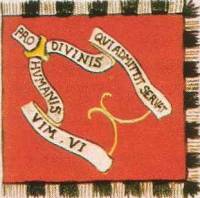 1) 1) |
| Active | 1645 to 1660 |
| Country | England |
| Allegiance | Parliamentarian |
| Conflicts | First Civil War |
| Second Civil War | |
| Confederate War | |
| Type | Horse |
| Colonel | Henry Ireton |
| Charles Fleetwood | |
| Thomas Cooper | |
| Henry Markham | |
| Area Raised | Kent |
| Flag Colour | Red |
| Flag Design | See below |
| Field Armies | NMA 1645-6 |
| Fairfax 1648 | |
| Ireton 1649-51 |
Later Colonel Charles Fleetwood’s, Thomas Cooper’s, then Henry Markham’s Regiment of Horse
New Model Army regiment of horse serving in the First and Second Civil Wars then in Ireland throughput the Commonwealth and Protectorate
Service History
1645
- April: Formed from Sir Michael Livesey’s Regiment of Horse of Waller’s Army
- 14th June: Battle of Naseby
- June: Siege of Leicester
- July: Skirmish at Crewkerne
- July: Battle of Ilminster
- August to September: Siege of Bristol
1646
- March: At Truro for Hopton’s surrender
- May to June: Siege of Oxford
1647
- August: Refuse to disband
1648
- May: Quartered at Chichester, Winchester and Bristol
- May: Regiment unites at Hounslow
- May: Garrison of Windsor Castle (1 troop)
- May: Taking of Dartford
- June: Battle of Maidstone
- June: Secure Canterbury
- Garrison of Windsor (1 troop)
- 11th June to 28th August: Siege of Colchester (3 troops led by Capt Cecil, 5 troops from July)
- July: Skirmish at Kingston (2 troops Maj Gibbon?)
- December: Occupy London
1649
- April: Selected by lot for service in Ireland
- May: Mutiny on being ordered to Ireland
- May: Mutiny quashed at Burford
- August: Shipped to Ireland
- September: Siege of Drogheda
- October to November: Siege of Duncannon?
1650
- February: Siege of Ardfinnan Castle?
- June to August: Siege of Waterford?
- August: Taking of Duncannon Fort?
- August: Taking of Charlemont Fort?
- August: Siege of Athlone?
- September to October: Siege of Limerick?
1651
- June: Taking of O’Briensbridge?
- June: Siege of Limerick?
- June: Taking of Athlone?
- November: Ireton dies, the regiment passes to Fleetwood
1652
- Serving in Ireland
1653
- Serving in Ireland
1654
- Serving in Ireland
1655
- Serving in Ireland
1656
- Serving in Ireland
1657
- Serving in Ireland
1658
- Serving in Ireland
1659
- July: Fleetwood passes the Colonelcy to Thomas Cooper
- Suppress a mutiny at Carrickfergus
- December: Cooper dies
1660
- Parliament votes in Henry Markham as Colonel
Notes
A history of the regiment is given in The Regimental History of Cromwell's Army by Sir Charles Firth and Godfrey Davies, Clarendon Press, Oxford, 1940.
The regiment was formed from Sir Michael Livesey’s Regiment of Horse but Livesey, although initially named as Colonel, was replaced by Ireton, who had previously served in Cromwell’s regiment. In command of the left wing at Naseby, Ireton attacked the Royalist foot, was unhorsed and run through the thigh with a pike, and into the face with an halbert, was taken prisoner by the enemy while the rest of his wing was scattered by Prince Rupert. Ireton escaped and recovered in time for the siege of Bristol and Fairfax’s Western Campaign.
At the start of the Second Civil War the regiment was quartered in the South and West, rendezvousing with Fairfax at Hounslow and serving at Maidstone and Colchester. Four troops of the regiment joined the Leveller mutiny of 1649, which ended with the capture of the mutineers by Fairfax and Cromwell at Burford. The two troops that remained under control appear to have been the basis of Ireton’s regiment as sent to Ireland. Likely they were supplemented with repentant mutineers and new recruits.
Ireton and his regiment served in Cromwell’s Irish campaign. Ireton was left in command while Cromwell returned to Britain to face the Scots. In December 1651 Ireton died and the regiment was given to his successor, Charles Fleetwood. It remained in Ireland until the Restoration, passing briefly to Colonel Thomas Cooper, then Colonel Henry Markham. The end of the regiment is still obscure.
Flags and Equipment
Colonl Henry Ireton
Ireton's cornet in the Eastern Association was red with a red and white fringe and a complicated white scroll PRO (used for both lines) DIVINIS QUI AMITTIT SERVAT and HUMANIS VIM VI2). (Illustration 1). Whether Ireton used this design in the New Model Army is unclear.
Major George Sedascue
Sedascue, thought to be German but in fact Polish, Johannes Sedowski, had a red cornet with the sun at top left, a storm cloud top right and the motto POST NUBILA PHREVE on a three part scroll. 3)
Notable Officers
Commissary General Henry Ireton
Henry Ireton (1611-1651)
Colonel Charles Fleetwood
Charles Fleetwood (c 1618-1692) was at the Inns of Court at the outbreak of the First Civil War and joined The Earl of Essex’s Lifeguard troop. By 1643 he was a captain of horse, was wounded at First Newbury and in 1644 was made colonel of horse in the Earl of Manchester’s army of the Eastern Association. In 1649 he was governor of the Isle of Wight, then in 1650 was appointed Lieutenant General of the Horse for Cromwell's Scottish campaign. Fleetwood married Bridget, Cromwell's daughter, in 1652 and was commander-in-chief in Ireland, appointed Lord-Deputy in 1654 but recalled in 1655. He was Major General of Hertfordshire, Oxfordshire, Buckinghamshire and East Anglia. After Oliver Cromwell's death in 1658, he supported Richard Cromwell for a while but soon challenged his authority, thus dissolving the Protectorate. He was appointed Commander-in-Chief in June 1659, but was replaced by a commission of seven members more acceptabe to Parliament. Fleetwood supported Lambert and was again appointed Commander-in-Chief, effectively leading the ruling junta but opposed on all sides he acquiesced to the recall of Parliament on the 6th of December 1659. After the Restoration he was barred from public office and retired peacefully to Stoke Newington.
Colonel Thomas Cooper
Thomas Cooper (d. 1659)
Colonel Henry Markham
Made commissioner for management of affairs in Ireland.
Major Anthony Morgan
Anthony Morgan (1621-1668) at first fought for the Royalists but came over to the Parliamentary side with Sir Trevor Williams in 1645. He impressed Fairfax, was given a captaincy in Ireton’s regiment and rose to be Major. He was a close ally of Henry Cromwell, sat as an Irish member in Parliament, but lost his commission in 1659, eventually ending up on the Royalist side once again and being knighted by Charles II. Pepys dined with him in 1668 and thought him a very wise man.
Officer Lists
More detailed lists of officers for April and May 1645, December 1646, May and August 1647 and May 1649 are shown in Reconstructing the New Model Army. Volume 1, Regimental Lists April 1645 to May 1649 by Malcolm Wanklyn, Helion & Co. 2015. ISBN 978-1-910777-10-7.
May 1645 and December 1646
From Anglia Rediviva4)
- Colonel: Commissary General Henry Ireton
- Major: George Sedascue
- Captain: William Guilliam, replaced by Capt Henry Pretty
- Captain: Robert Gibbons
- Captain: John Hoskins, replaced by Capt William Cecil
- Captain: John Barry, replaced by Capt Anthony Morgan
Strength
- 1645: Established at six troops